Behind the simple cash withdrawal interface, an ATM operates through integrated hardware, software, and secure banking networks. It relies on real-time transaction processing, cash management systems, security protocols, and regular maintenance to ensure uninterrupted performance across large-scale deployments. In this guide, we’ll break down ATM technology, services, and business models in a simple way so you can clearly understand how this essential financial machine works.
Key Takeaways
- Deciding Between Buying, Leasing, or Free ATM Placement: Finding the Best Option for Your Business
- Comparing ATM Machine Models, Features, and Brands to Identify the Right Choice
- ATM Branding, Surcharge Income, and Methods to Increase Customer Traffic Inside Stores
- How to Launch an ATM Business: Setup Costs, Legal Requirements, and First-Time Installation
- ATM Transaction Processing, Interchange Fees, and the Flow of Revenue Explained
- ATM Protection, Regulatory Compliance, EMV Standards, and Securing Your Investment
- Cash Dispensers vs Cash Recyclers: Key Insights for Banks and Financial Institutions
- Modern Branch Transformation: Enhancing Customer Experience with Cash Automation Systems
- Choosing the Right ATM Service Provider: What Banks and Credit Unions Should Look For
ATM Machines for Businesses: Buy, Lease, or Place a Free ATM
ATMs help businesses, banks, and operators improve cash access, increase foot traffic, and generate additional revenue through flexible ownership and placement models. Let’s find out the basis of their differences.
Businesses have a few simple ways to add an ATM: leasing an ATM, buying your own ATM, vs a Placement ATM.
- Buying gives full ownership and all earnings.
- Leasing keeps costs lower with support included
- Free placement requires no upfront investment, with profits shared.
Each option fits different budgets and business needs.
How Free ATM Placement Programs Work and What the Business Owner Gets
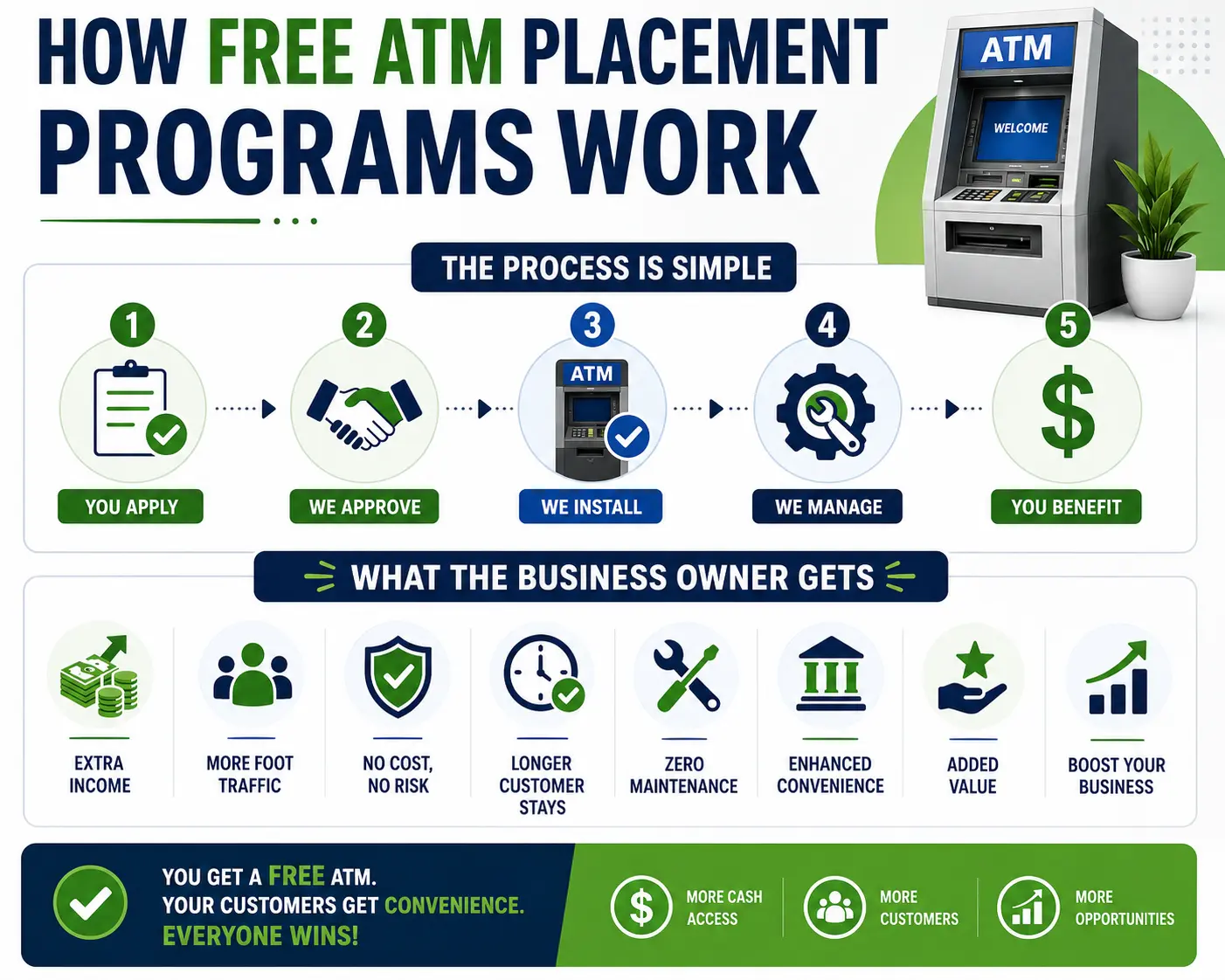
Free ATM placement programs allow business owners to host an ATM at their location without any upfront cost while earning passive income from transaction activity and increasing customer visits.
What is the difference between purchasing an ATM and leasing it
ATM Purchase
An ATM benefit of full ownership is that it involves a higher initial capital outlay covering the machine, installation, PCI compliance setup, and processor integration for transaction routing. Monthly Fees are variable, including processing charges, network connectivity, and maintenance. In terms of long-term ROI, earnings are higher because surcharge revenue stays with the owner after breakeven, making it more profitable in high-traffic locations over time.
ATM Lease
With leasing, the ATM is deployed and owned by the provider, who supplies and installs the machine with no major investment required. Monthly fees are fixed and usually include equipment usage, monitoring, maintenance, and support services. For long-term ROI, returns are lower due to recurring lease payments, but it offers predictable costs and easier management without technical or operational responsibilities.
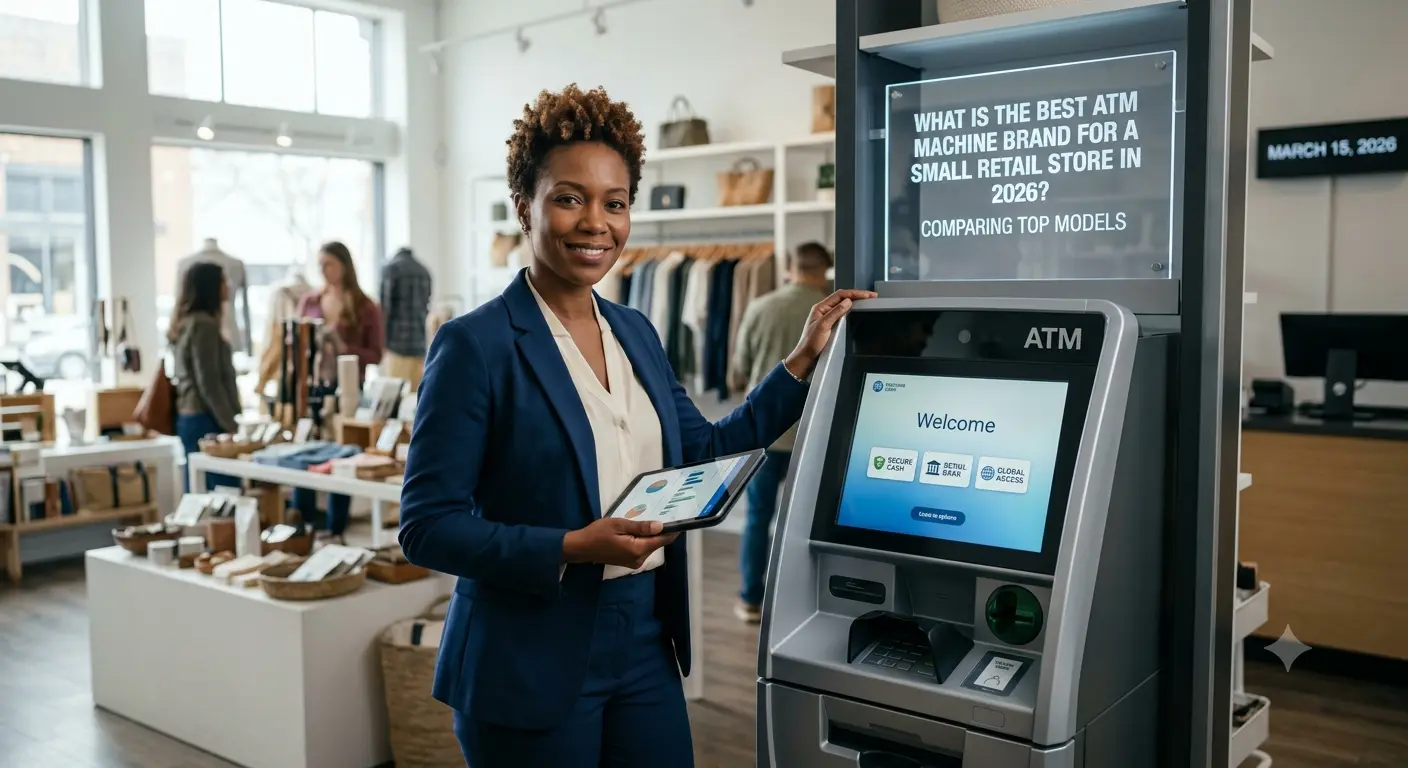
Best ATM Machines for Retail: Models, Features, and Brand Comparison
Some of the best ATM brands to buy include Hyosung and Genmega, which are designed to balance reliability, security, and ease of operation, offering different models and features that suit varying store sizes, transaction volumes, and business needs.
Hyosung, Genmega, Hantle, and Triton: Key Differences for Retail Buyers
A quick comparison of Hyosung, Genmega, Hantle, and Triton helps simplify ATM selection for retail businesses.
| Brand | Hardware Architecture | Software / OS | Cash Handling System | Connectivity & Integration | Serviceability |
|---|---|---|---|---|---|
| Hyosung | Modern modular chassis, high-resolution touchscreen units in newer models |
Windows-based + proprietary UI layer (Nautilus platform in many models) |
High-speed dispensers, multi-cassette options (up to 4–5 cassettes in premium units) |
Strong API support for processors, remote monitoring (RMM), and PCI-compliant upgrades |
Designed for easy module swaps and remote diagnostics |
| Genmega | Mid-tier modular design, compact internal layout | Embedded Windows / Linux hybrid (model-dependent) | Standard 1–2 cassette systems, reliable mid-speed dispense units | Compatible with most U.S. processors, basic remote monitoring | Very service-friendly, simple internal access |
| Hantle | Traditional mechanical engineering, fewer modular electronics | Older Windows Embedded systems in many models | Robust but slower dispensers, typically 1–2 cassettes | Limited but stable processor integration | Requires more manual servicing |
| Triton | Heavy-duty steel frame construction, industrial-grade parts | Proprietary embedded OS (minimal UI complexity) | High-durability dispensers, optimized for high-volume cash loads | Strong compliance focus, basic integration options | Extremely durable, low failure rate |
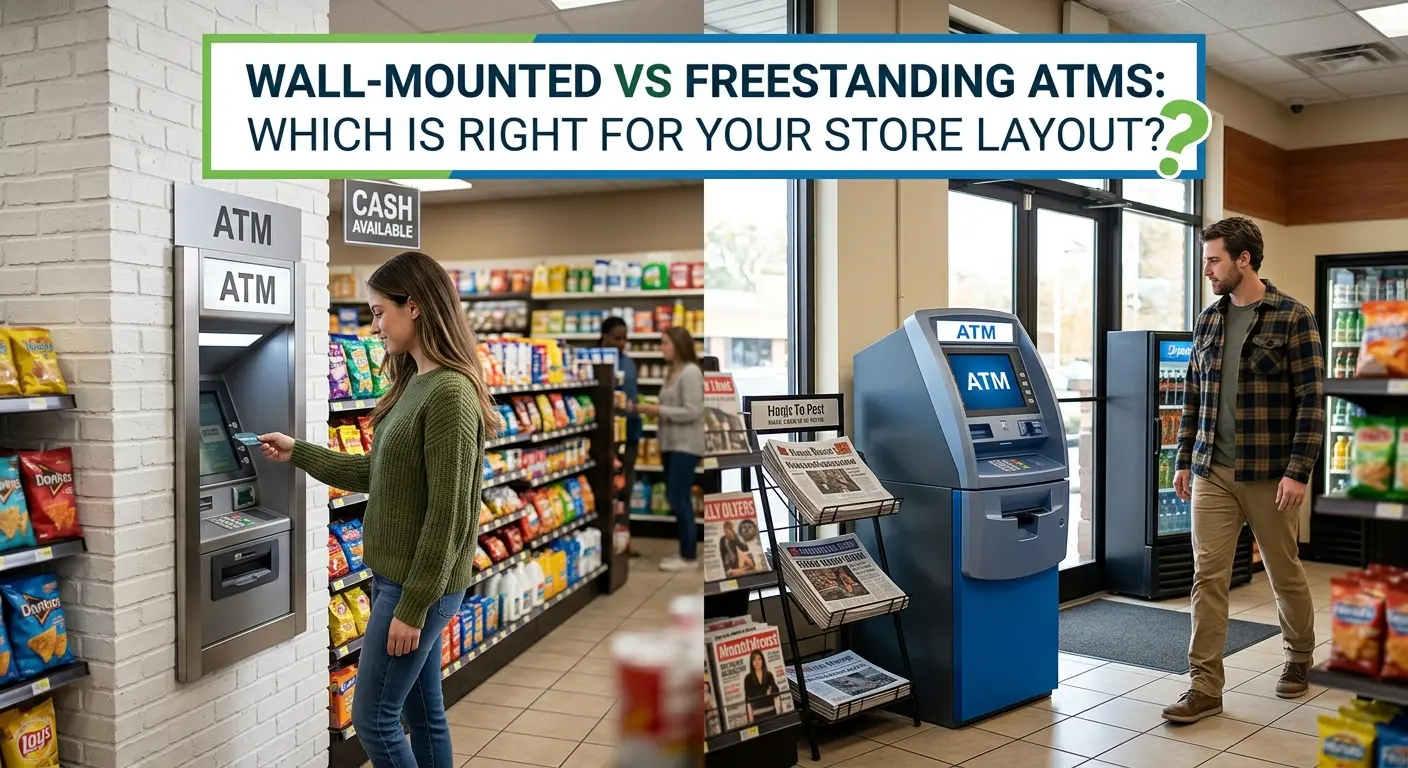
Wall-Mounted vs Freestanding ATMs: Space, Placement, and Foot Traffic Considerations
A closer look at wall-mounted ATMs vs. freestanding ATMs shows how thoughtful design choices can improve layout efficiency while enhancing customer flow and overall accessibility.
| Factor | Wall-Mounted ATMs | Freestanding ATMs |
|---|---|---|
| Space Engineering | Integrated into a wall recess or mounted frame, reducing external footprint while maintaining ADA/aisle clearance compliance in compact retail layouts. |
Self-contained cabinet with full-depth chassis and safe unit, requiring a dedicated clearance zone for user access and technician servicing on multiple sides. |
| Installation & Placement Constraints | Dependent on structural wall strength, concealed conduit routing for power/data lines, and pre-defined installation points, making repositioning impractical once deployed. |
Not structure-dependent; installed via floor anchoring with external power/network access, allowing relocation based on performance, traffic flow, or store redesign. |
| Customer Flow Interaction (Foot Traffic Impact) | Works within linear traffic paths where transactions occur parallel to store movement, minimizing congestion and maintaining steady queue flow. |
Creates a 360° engagement zone in open retail areas, increasing visibility radius but requiring careful placement to avoid clustering in high-density intersections. |
ATM Branding, Surcharge Revenue, and Maximizing In-Store Foot Traffic
ATM branding helps the machine stand out and builds customer trust, encouraging more usage. Surcharge revenue is earned from each transaction, creating a consistent income stream for the business. Together, strong visibility and smart placement help maximize in-store foot traffic by drawing customers toward the machine area.
ATM Screen Branding, Custom Wraps, and How Branded ATMs Build Customer Trust
- ATM screen branding involves customizing the ATM interface to reflect a brand identity using logos, colors, fonts, button layouts, welcome messages, and receipt headers. It ensures a consistent digital experience and improves user familiarity during transactions.
- Custom ATM wraps are durable vinyl coverings, often premium 3M material, applied to ATM exteriors to enhance branding and protect against scratches, UV fading, moisture, and wear.
- Branded ATMs enhance user confidence by presenting a professional, secure, and well-maintained appearance that reassures customers and encourages more frequent usage.
Surcharge Fees, Surcharge-Free Networks, and How to Maximize Monthly ATM Income
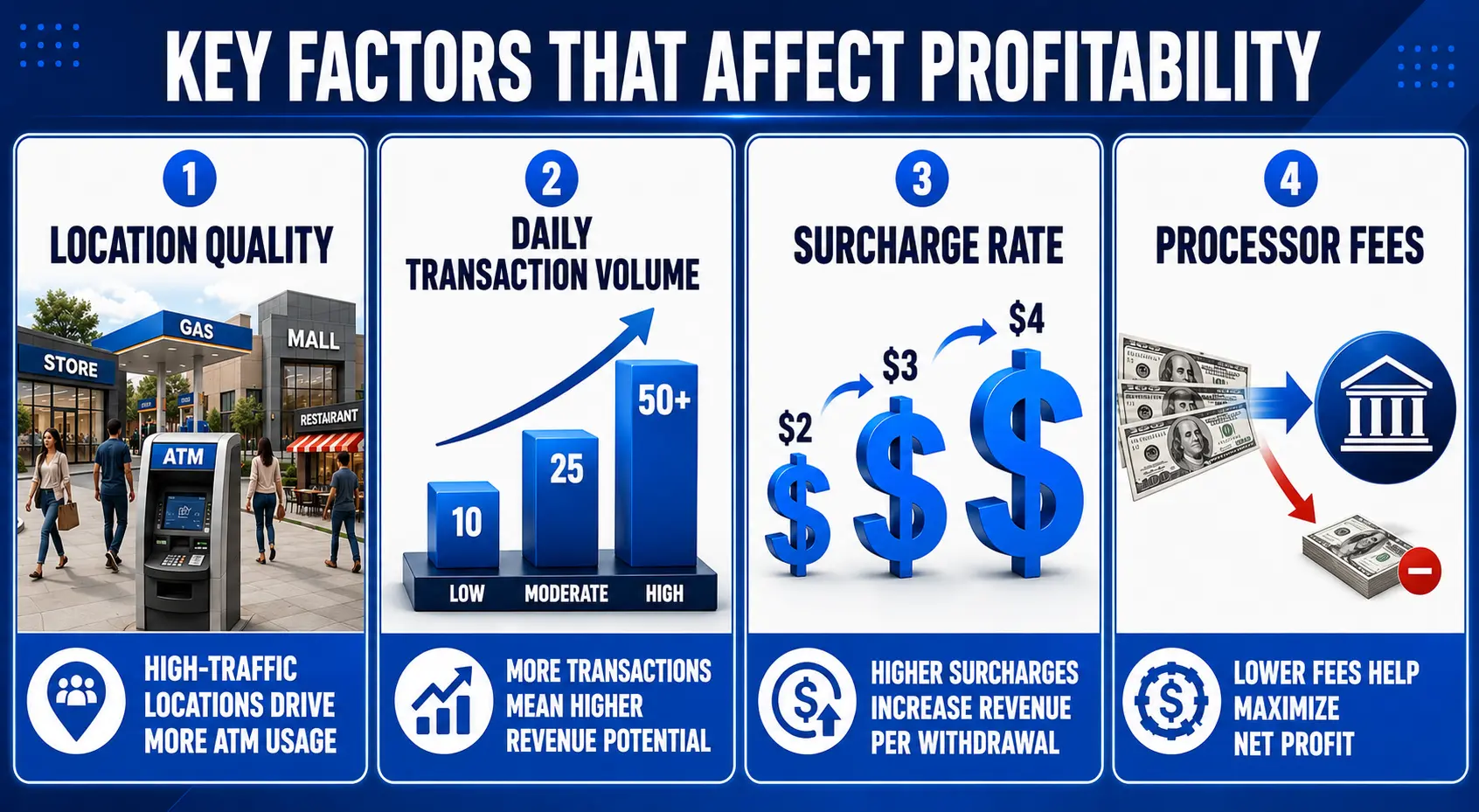
Surcharge fees are small charges (usually around $2–$5) applied per ATM withdrawal and are earned as income by the operator, whereas surcharge-free models generate revenue through interchange payments based on transaction volume. To maximize your ATM income, the key factors are placing machines in high-traffic, cash-heavy locations, ensuring high uptime with minimal downtime, and maintaining consistent cash availability. Managing processor costs and balancing surcharge vs. surcharge-free setups also helps improve overall profitability.
How to Start and Run a Profitable ATM Business
Starting an ATM Business: Costs, Legal Setup, and First Machine
Starting an ATM business involves more than just installing a machine; it requires careful planning around investment, permissions, and location strategy. From understanding setup costs to meeting banking and regulatory requirements, each step plays a key role in ensuring smooth operations. Finding the Best ATM Locations can significantly impact cash flow and long-term profitability.
S-Corp vs LLC, Business Banking, and ATM-Friendly Banks by State
A clear comparison of S-Corp vs LLC, business banking requirements, and ATM-friendly banking helps simplify the setup process for an ATM business.
| Topic | Technical Information |
|---|---|
| S-Corp vs LLC | How to start an ATM business in 2026 is a common question for new entrepreneurs. Most operators choose an LLC (Limited Liability Company) because it is easier to manage and offers personal liability protection. It also keeps taxes simple, as profits pass to the owner without payroll.An S-Corp (S Corporation) is considered when the business grows and generates stronger profits. It can reduce certain tax liabilities by separating salary from profit distributions, but it adds more paperwork, payroll obligations, and reporting requirements. |
| Business Banking | A dedicated business bank account is important for ATM surcharge income, cash replenishment, and payment processing. Banks typically ask for EIN, registration documents, ownership details, and operating agreements before opening an account. Since ATM businesses deal with cash, banks review transaction activity to understand operations. |
| ATM-Friendly Banks by State | When exploring ATM business friendly banks by state, it’s important to note that states like California, Texas, Florida, New York, and Illinois offer banking networks for ATM operators. Many business owners work with JPMorgan Chase, Wells Fargo, and Bank of America, while regional banks and credit unions may offer flexible support on setup. |
How Much Does It Cost to Start an ATM Business and What Your First 90 Days Look Like
Starting an ATM business usually requires an upfront investment of around $3,000–$10,000 or more per machine, depending on the equipment quality, setup needs, and initial cash load. Beyond the machine itself, you’ll also need extra working capital to keep cash available for withdrawals. The overall cost can vary based on the location you choose, expected foot traffic, and whether you decide to buy or lease the ATM.
You can refer to our blog, a beginner’s guide to buying an ATM, for more detailed information on ATM buying options and processes.
How the First 90 Days Look:
- Week 1–2: Business Setup Completion: This stage generally involves completing the core setup work, such as forming the business entity, opening a business bank account, and finalizing ATM processor or ISO arrangements so the business can operate smoothly.
- Week 3–4: Location Finalization: At this point, the focus is usually on identifying and negotiating with potential locations like retail stores or high-footfall areas where ATM placement can be viable.
- Week 5–6: Installation & Activation: Once a location is secured, the ATM is typically installed, connected to the processing network, and prepared for live transactions after initial cash loading.
- Week 7–10: Monitoring Phase: After going live, attention shifts to observing transaction activity, cash usage patterns, machine uptime, and overall customer demand to understand performance trends.
- Week 11–12: Optimization Stage: In the final phase, operators may review surcharge settings, improve cash management cycles, and assess whether the location is performing well enough to maintain or scale further.
ATM Processing, Interchange Fees, and How the Money Actually Works
Understanding how ATM transactions are routed and how fees are distributed is essential for maximizing profitability and avoiding hidden costs. Come, let’s read more about it:
ATM Processing Networks and Choosing the Right Processor
Every ATM transaction moves through networks like Visa, NYCE, or Star, generating interchange fees split between banks and operators. Your processor choice directly controls what you keep. Also, understanding ATM interchange fees before signing anything is non-negotiable.
Here’s how it actually breaks down:
- Surcharge fee: It is set by the ATM operator, charged directly to the cardholder at the time of withdrawal, and paid out to the operator.
- Interchange fee: This is paid by the cardholder’s bank to the ATM operator’s processor for providing cash access through their network.
- Switch fee: A per-transaction routing cost charged by the network, like Visa, etc., to move the transaction between institutions.
- Processor margin: Your ISO or processor retains a portion of interchange, making their cut invisible unless you negotiate a transparent pass-through agreement.
- Network participation fees: Monthly or annual fees for being connected to specific networks, regardless of transaction volume.
What to demand from your processor:
- Detailed transaction-level reporting that clearly shows every fee rather than combining charges into broad summaries.
- Pass-through interchange pricing that lets you receive actual network rates instead of paying hidden processor markups.
- Flexible contract terms that avoid lengthy commitments unless backed by clearly defined service-level guarantees.
- Multi-network access to avoid single-network dependency.
How Profitable is an ATM Machine: Income Calculations and Real ROI Numbers
Want to know how profitable is an ATM Machine for you, then it depends on:
ATM Security, Compliance, EMV, and Protecting Your Investment
As ATM fraud techniques continue to evolve, strong security controls and regulatory compliance have become essential for protecting revenue, customer data, and long-term business operations.
ATM Jackpotting, Skimming, and Physical Security Measures Every Operator Needs
In ATM jackpotting, a criminal uses malware or black-box devices to force unauthorized cash dispensing, while skimming means capturing card data through hidden overlays. These threats are not theoretical. The U.S. Secret Service confirms that skimming crimes cost financial institutions and consumers more than $1 billion every year in the United States alone. That’s why every operator needs to protect machines and their cardholder data through:
- Encrypted card readers
- Anti-skimming hardware
- Tamper-alert systems
EMV Compliance, PCI TR-31 Mandates, and What Non-Compliance Costs You
Europay, Mastercard, and Visa are the global chip-card standard that authenticates transactions through an encrypted chip rather than a magnetic stripe. The PCI TR-31 is a separate but related mandate that governs how encryption keys are managed inside your ATM’s PIN pad (EPP). It ensures that the keys protecting cardholder PIN data are stored and transferred securely. Both are active compliance requirements today, not future recommendations. So, non-compliance with these can:
- Shift full fraud liability onto the operator
- Expose the business to processor termination
- Trigger network fines
Teller Cash Automation for Banks and Credit Unions
As financial institutions face growing pressure to improve efficiency while controlling operational costs, teller cash automation has become a key part of modern branch strategy.
Teller Cash Dispensers and Teller Cash Recyclers: What Financial Institutions Need to Know
One of the most frequent searches is what is a teller cash dispenser? Well, it’s simply a cash-out only machine, as it automates the dispensing side of a teller’s work. On the other hand, a teller cash recycler is a two-way machine that handles both cash intake and cash dispensing. For bank branch managers, credit union operations teams, and financial institution decision-makers, understanding this core difference is what makes everything else, like cost, workflow impact, integration, and ROI, fall into place.
How Teller Cash Recyclers Work and Where They Beat Traditional Vault Processes
A teller cash recycler works by accepting the deposited cash, then verifying and sorting it internally, and then holding it ready for the next dispensing request, all within one continuous closed loop. This reduces manual vault counting, balancing errors at the end of the day, and removes the back-and-forth cash movement between teller drawers and vault that traditional processes depend on.
Cost, Workflow Impact, and Which Fits Your Branch Size and Volume
TCD
- Cost: Lower upfront investment, typically $15,000–$25,000 per unit. The ongoing costs are minimal since the machine only dispenses.
- Workflow: Automates cash-out only. So, the deposits, vault replenishment, and end-of-day balancing still require manual teller involvement.
TCR
- Cost: Higher initial investment, typically $30,000–$60,000 per unit; offset over time through reduced labor hours and cash handling errors. So, if you’ve been wondering how much a teller cash recycler costs, it must be clear to you now.
- Workflow: It handles both cash intake and dispensing in one cycle and integrates directly with core banking platforms, eliminating dual-process handling entirely.
Which one to go for?
- If your branch runs high daily cash volume with mixed deposit and withdrawal demand, a TCR delivers stronger long-term operational ROI. A TCD is the right fit for lower-volume branches where automated dispensing on its own resolves the bottleneck.
Branch Transformation: Modernizing the In-Branch Experience with Cash Automation
Let’s understand how today’s branches are being redesigned around convenience and customer engagement:
ITMs vs ATMs: How Interactive Teller Machines Are Reshaping Branch Strategy
An Interactive Teller Machine connects customers to a live remote teller via video, enabling full-service transactions, like account openings, loan payments, and complex inquiries that a standard ATM cannot handle. So, branches deploying ITMs are extending service hours beyond staffed windows, reducing the number of on-site tellers required per shift, and serving customers who need human assistance without the cost of a dedicated branch window.
If you want to know more about the comparison, check out our blog on ATMs vs ITMs.
How Cash Automation Reallocates Staff, Reduces Risk, and Improves Customer Experience
When cash automation handles counting, sorting, and balancing, tellers stop being cash handlers and start being relationship managers. That reallocation reduces human error in cash reconciliation, shortens transaction wait times during peak hours, and measurably improves the customer experience.
Choosing an ATM Service Provider: What Banks and Credit Unions Should Demand
The right ATM service partner can reduce operational burdens and help financial institutions deliver a more reliable customer experience across their entire ATM network.
ATM-as-a-Service (ATMaaS): Managed Services, SLAs, and What Full Outsourcing Looks Like
ATM-as-a-Service means the service provider takes care of the:
- ATM hardware
- Cash handling
- System monitoring
- Maintenance
- Compliance requirements
The financial institution still keeps its branding and access to transaction data, while the provider follows a service level agreement that outlines uptime targets and response times. If you want to understand why more institutions are moving in this direction, our blog on the rising popularity of managed ATM services breaks it down in detail.
Evaluating Service Response Times, Parts Availability, and Maintenance Track Records
Response time commitments, four hours or under for critical failures, and verified parts inventory depth are the two metrics that separate capable providers from those that look good on paper. Other than that, ask your ATM service provider about:
- Documented maintenance histories
- Any certified technician coverage across your deployment geography
Conclusion
All in all, getting the foundation right from the start is what separates your operations that scale from those that stall. So, if you’re looking for a trusted partner to deploy, manage, or service your ATM infrastructure, Best Products Sales & Service is your answer to that. We provide end-to-end ATM solutions, built for businesses and financial institutions that demand reliability.
When ATM reliability is non-negotiable, trust Best Products Sales & Service. Contact us for more information.
FAQs- About ATMs For Business Use
What triggers a chargeback on an ATM transaction, and who absorbs the loss?
The chargebacks are triggered by disputed transactions, like a failed dispensing or unauthorized use. Liability falls on the operator if the machine is non-compliant or lacks proper transaction logging.
Is it possible that multiple ATMs can be managed from a single monitoring platform?
Yes. Remote management systems allow operators to monitor cash levels, uptime, transactions, and alerts across entire ATM fleets.
Can my retail ATM be converted into a full branch ITM?
It depends on your hardware. Some advanced machines like Hyosung support ITM upgrades, but require added hardware, core banking integration, and remote teller infrastructure.
If someone steals money from my ATM, am I responsible?
Physical theft liability depends on your insurance coverage and placement agreement terms. But, cyber-related cash loss through jackpotting or skimming fraud liability falls on the operator if the machine is non-compliant.
What happens to an ATM business if the host location closes down?
The operator must relocate the machine. A well-drafted placement agreement should include exit clauses, relocation timelines, and equipment removal terms to protect against sudden site loss.
Follow Us on Social
Peter Wilkenshoff
Peter Wilkenshoff is the President of Best Products Sales and Service Inc./ BestATMstore.com. With more than 20 years in the payments industry, he has made a career out of helping businesses get paid in the simplest and smartest ways possible. Cash, cards, mobile wallets or whatever futuristic payment gadget someone invents next week, he is here for it. He loves taking the stress out of money movement and turning complex processes into something anyone can understand. When he is not working he is usually fishing, building something around the house, out on a boat, surfing or planning the next family Disneyworld trip which sounds like a strange mix until you meet him and suddenly it all adds up.
Follow Peter on LinkedIn: https://www.linkedin.com/in/peter-wilkenshoff/
Join our Newsletter