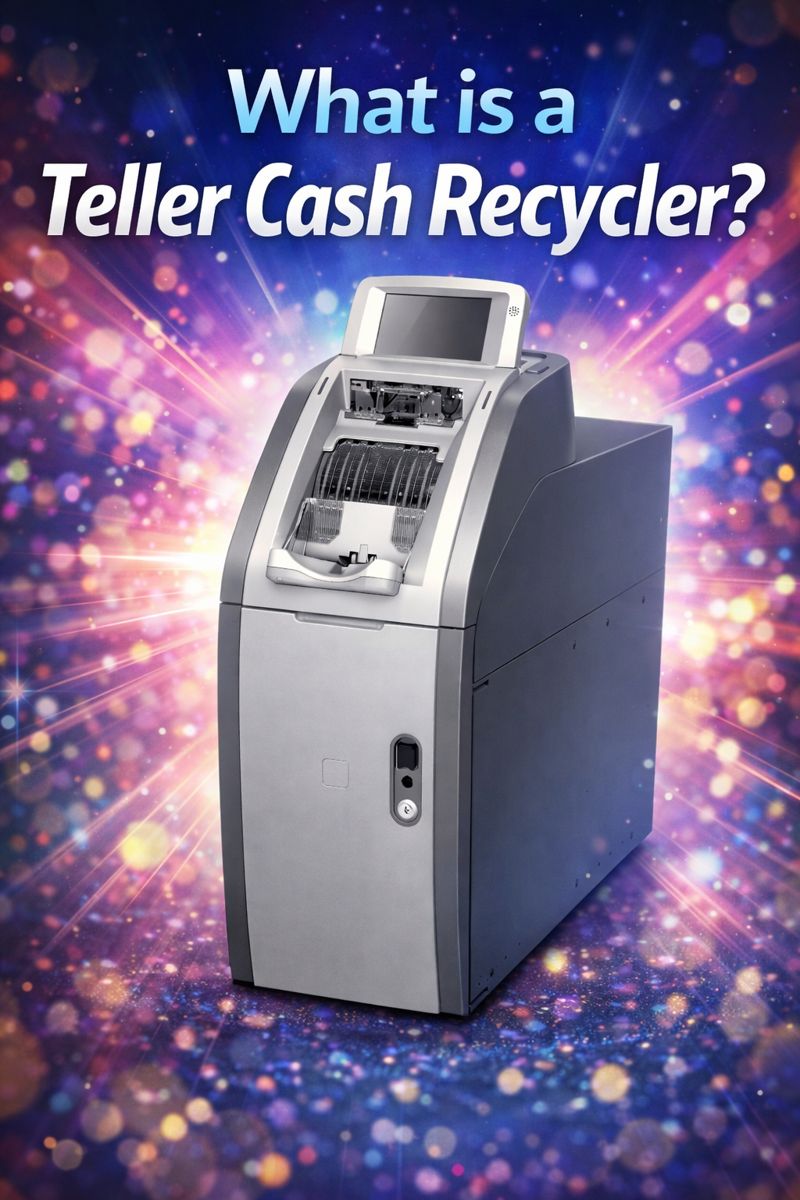
How Much Does a TCR Cost? Why ROI Matters More Than Price
When financial institutions ask, “How much does a TCR cost?”, they are usually searching for a single number. A price. A line item. Something that can be compared across vendors and placed neatly into a capital budget.
But focusing only on price is the fastest way to misunderstand the true economics of a Teller Cash Recycler.
A TCR is not simply a piece of branch hardware. It is an operational tool that fundamentally changes how cash is handled, how labor is deployed, and how efficiently a branch runs day after day. That is why the question “How much does a TCR cost?” cannot be answered responsibly without discussing return on investment.
How Much Does a TCR Cost? The Number Most People Start With
Most teller cash recyclers on the market today fall somewhere between $15,000 and $40,000, depending on capacity, configuration, and service coverage. That number is real, and it matters, but it is only the beginning of the conversation.
When institutions stop here, they treat the TCR as a static expense rather than a dynamic operational asset. They compare one price to another without examining what the technology replaces, reduces, or improves. This is where costly mistakes begin.
Asking “How much does a TCR cost?” without asking what it does to branch economics is like evaluating a new core system based solely on licensing fees while ignoring productivity, scalability, and long-term impact.
Why Price Alone Fails as a Decision Metric
The reason price-only evaluations fail is simple: the largest costs in a retail branch are not machines, software, or equipment. The largest costs are people and time.
Labor represents the most significant ongoing expense in branch operations. Every minute a teller spends counting cash, walking to the vault, reconciling drawers, or resolving discrepancies is a minute not spent serving customers or generating value. Those minutes accumulate into hours, days, and eventually full-time salaries.
This is where the question “How much does a TCR cost?” starts to lose relevance. Even a relatively expensive TCR often costs less per year than a fraction of one full-time teller when fully loaded labor costs are considered.
Labor Economics: The Core of TCR ROI
A fully loaded teller, once benefits, payroll taxes, training, and turnover are included, often costs a financial institution tens of thousands of dollars per year. That cost exists regardless of how efficiently the teller’s time is used.
A Teller Cash Recycler directly targets inefficiency in teller workflows. By automating cash counting, storage, dispensing, and reconciliation, the TCR removes a significant portion of manual effort from every transaction. Over the course of a day, that time savings becomes substantial.
Branches that deploy TCRs frequently find they can handle the same transaction volume with fewer tellers on the line, or with the same staff working fewer hours under pressure. In many cases, two tellers with a TCR can comfortably perform the work that previously required three.
When institutions ask “How much does a TCR cost?”, they should be comparing that cost not to another machine, but to the labor expense it offsets year after year.
Transaction Efficiency and the Cost of Time
Every teller transaction has an embedded cost. It includes not only wages, but also system time, customer wait time, and the operational friction created by manual cash handling.
Traditional teller lines slow down because cash is handled multiple times in multiple places. A TCR simplifies that process by centralizing cash handling into a secure, automated system that serves the teller instantly.
The result is faster transactions, smoother peak periods, and less congestion at the teller line. Even if transaction volume remains flat, the cost per transaction decreases because each interaction requires less time and less effort.
This is an often-overlooked component of the answer to “How much does a TCR cost?”. Speed is not just a customer experience benefit; it is an operational cost reducer.
Vault Activity: An Invisible Drain on Productivity
Vault transactions are one of the most underestimated costs in branch operations. Each vault buy or sell requires dual control, compliance documentation, and the attention of experienced staff. It interrupts customer service and introduces operational risk.
In branches without TCRs, vault activity can occur dozens of times per day. With a Teller Cash Recycler, that number typically drops dramatically. Cash is stored securely within the recycler and made available directly at the point of service.
This reduction in vault activity frees up staff time, simplifies compliance, and reduces the overall risk profile of the branch. While these benefits may not always appear clearly in a spreadsheet, they materially affect operational efficiency.
Again, asking “How much does a TCR cost?” without accounting for reduced vault dependency tells only part of the story.
Risk Reduction and Operational Stability
Cash discrepancies are costly, not only in terms of dollars but also in management time and staff morale. Manual cash handling introduces opportunities for error that must later be investigated, documented, and corrected.
Teller Cash Recyclers significantly reduce cash exposure by automating reconciliation and enforcing consistent controls. Fewer discrepancies mean fewer exceptions, fewer investigations, and fewer disruptions to daily operations.
This stability has real value, even if it is not always easy to quantify. Over time, reduced risk contributes meaningfully to the ROI conversation behind how much a TCR costs.
Annual Cost vs. One-Time Price
A more useful way to frame the question “How much does a TCR cost?” is to look at annualized expense rather than upfront price.
When a TCR is spread over its useful life and combined with service and maintenance, the annual cost is often far lower than expected. In many cases, that annual cost is comparable to a small portion of one employee’s compensation.
Viewed this way, the TCR becomes less of a capital expense and more of a productivity investment. It replaces inefficient labor with consistent automation and delivers returns every day it is in use.
Where ROI Actually Comes From
The strongest return on investment from a Teller Cash Recycler does not come from one single factor. It comes from the compounding effect of labor efficiency, faster transactions, reduced vault activity, lower error rates, and improved operational flow.
Institutions that focus only on how much a TCR costs at the time of purchase often miss these cumulative benefits. Institutions that focus on ROI see the TCR as a long-term contributor to branch performance rather than a one-time expense.
In many real-world deployments, the payback period for a TCR is measured in months, not years. After that point, the technology continues to generate savings and efficiency gains throughout its lifespan.
The Real Cost of Asking the Wrong Question
So, how much does a TCR cost?
By now, it should be clear that this is not really the question that matters most.
The real cost to a branch is not the price of a Teller Cash Recycler. The real cost is the labor inefficiency that continues every day without one. It is the time tellers spend counting and recounting cash. It is the disruption caused by constant vault activity. It is the slow transactions, the growing operational friction, the increasing labor costs, and the ongoing risk that comes with manual cash handling.
When viewed through that lens, the conversation changes.
It stops being about what a TCR costs to buy and starts being about what it costs not to have one. Every day a branch operates without a TCR, it pays for that decision in labor hours, lost productivity, and avoidable inefficiencies. Those costs don’t show up as a single line item, but they compound quietly over time.
So perhaps the better question is not “How much does a TCR cost?”
Perhaps the better question is how much is not having a TCR costing you — every single day.
That is the question that leads to smarter decisions, stronger ROI, and more efficient branches.
Bring Smarter Cash Control to Your Branch
Automated cash handling designed for today’s banks and credit unions. Talk to an expert.
Ready to Get Started?
If you’re evaluating Teller Cash Recyclers and want practical guidance instead of sales jargon, you’re in the right place.
We’ll help you understand:
- How Teller Cash Recyclers work in real branch environments
- Where they fit within your teller line or branch layout
- What operational benefits to expect day-to-day
- How they improve accuracy, security, and cash control
- And how to choose the right configuration for your institution
Contact Us when you are ready to get started!
Whenever you’re ready, we’re only a call or message away.
Follow Us on Social
Peter Wilkenshoff
Peter Wilkenshoff is the President of Best Products Sales and Service Inc./ BestATMstore.com. With more than 20 years in the payments industry, he has made a career out of helping businesses get paid in the simplest and smartest ways possible. Cash, cards, mobile wallets or whatever futuristic payment gadget someone invents next week, he is here for it. He loves taking the stress out of money movement and turning complex processes into something anyone can understand. When he is not working he is usually fishing, building something around the house, out on a boat, surfing or planning the next family Disneyworld trip which sounds like a strange mix until you meet him and suddenly it all adds up.
Follow Peter on LinkedIn: https://www.linkedin.com/in/peter-wilkenshoff/
Join our Newsletter