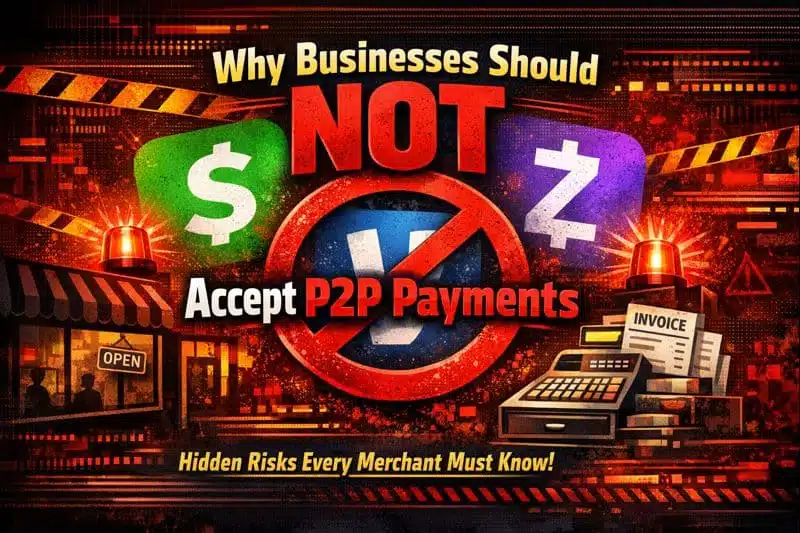
Why Businesses Should Not Accept P2P Payments
Peer-to-peer payment platforms have become widely recognized as fast and convenient ways to move money. As a result, Venmo, Zelle, Cash App, Apple Cash, and similar tools have increasingly been used in business settings. However, as payment environments continue to evolve, it has become clear why businesses should not accept P2P payments in most commercial situations.
Although these platforms appear simple on the surface, they were not designed to support business transactions. Consequently, financial, reporting, and compliance risks are introduced that many businesses are not equipped to manage.
Why Businesses Should Not Accept P2P Payments in a Commercial Environment
To begin with, P2P payment platforms were created for personal use. Money was intended to be exchanged between individuals who already know and trust one another. Reimbursing a friend, paying the babysitter. That being said, business-grade safeguards were never built into these systems.
As a result, when P2P payments are accepted by businesses, transactions are processed outside of established commercial payment frameworks. Over time, gaps in documentation, accountability, and customer expectations are created. For this reason, these platforms are poorly suited for structured business operations.
Reporting Limitations That Cannot Be Ignored
One of the most significant reasons why businesses should not accept P2P payments involves reporting. While some platforms provide transaction histories, business-ready reporting is not consistently available.
With Venmo, basic summaries may be accessed, and transaction data may be downloaded. However, itemized records, product-level detail, and clean accounting integrations are not provided. As a result, reconciliation must be performed manually. Over time, administrative burden increases, and errors become more likely.
In contrast, Zelle reporting is handled entirely through a bank. Transactions are typically displayed as simple deposits without sales context. No customer records, receipts, or invoicing tools are included. Consequently, documentation must be maintained separately, increasing audit and compliance risk.
Across other P2P platforms, similar limitations exist. Transaction histories may be visible, but standardized receipts, structured reporting, and accounting integrations are not provided. Therefore, reliable financial oversight becomes difficult to maintain.
Increased Risk of Account Restrictions and Disruptions
In addition to reporting concerns, account stability remains a major issue. P2P platforms rely heavily on automated monitoring systems. As a result, accounts may be restricted or frozen when activity triggers fraud or compliance reviews.
When this occurs, access to funds may be delayed without clear timelines. Support channels are often limited, and resolution processes lack transparency. Consequently, cash flow interruptions may be experienced at critical moments. For businesses, this level of uncertainty creates unnecessary operational risk.
Customer Expectations and Professional Perception
Beyond operational issues, perception plays an important role. P2P payments are commonly associated with casual transactions, reimbursements, or side businesses. Therefore, when they are presented in a professional business setting, confusion or hesitation may be introduced.
In contrast, traditional merchant payments are widely recognized as standard business practices. As a result, credibility and trust are more easily established when formal payment systems are used.
The Narrow Exception for Small Mom-and-Pop Businesses
That said, limited exceptions do exist. In small, owner-operated businesses where the owner works on-site daily, personally manages transactions, and knows customers directly, P2P payments may be manageable in certain situations.
In these cases, oversight is provided manually. Payments are reviewed individually, issues are resolved directly, and records are tracked by the owner. However, this approach relies heavily on personal involvement and does not scale well.
Once employees are added, transaction volume increases, or external accounting requirements are introduced, these informal controls become insufficient. As a result, even for small businesses, long-term reliance on P2P payments remains risky.
Why Businesses Should Not Accept P2P Payments in 2026
As regulatory scrutiny increases and reporting expectations continue to rise, the limitations of P2P platforms are becoming more pronounced. These tools were not designed to support audits, structured reporting, or predictable operational workflows.
For this reason, it should be understood why businesses should not accept P2P payments in most cases in 2026. Convenience alone does not outweigh the risks associated with poor reporting, account instability, and compliance exposure.
Final Thoughts on Why Businesses Should Not Accept P2P Payments
In conclusion, P2P payment platforms may serve a limited role in very small, owner-managed environments. However, for most businesses, they introduce more risk than benefit.
Because business operations depend on predictability, documentation, and accountability, payment systems designed specifically for commerce remain essential. Ultimately, that is why businesses should not accept P2P payments except in the narrowest of circumstances.
Upgrade Your Credit Card Terminal Today
Simple, reliable terminals with transparent pricing. Talk to an expert.
Ready to Get Started?
If you’re evaluating merchant services and want clear answers instead of confusing statements, you’re in the right place.
We’ll help you understand:
- How to choose the right processor
- What fees matter—and which ones don’t
- How to select the right credit card terminal
- Where hidden costs usually show up
- And how to structure payments for long-term savings
Contact Us when you are ready to get started!
Whenever you’re ready, we’re only a call or message away.
Follow Us on Social
Peter Wilkenshoff
Peter Wilkenshoff is the President of Best Products Sales and Service Inc./ BestATMstore.com. With more than 20 years in the payments industry, he has made a career out of helping businesses get paid in the simplest and smartest ways possible. Cash, cards, mobile wallets or whatever futuristic payment gadget someone invents next week, he is here for it. He loves taking the stress out of money movement and turning complex processes into something anyone can understand. When he is not working he is usually fishing, building something around the house, out on a boat, surfing or planning the next family Disneyworld trip which sounds like a strange mix until you meet him and suddenly it all adds up.
Follow Peter on LinkedIn: https://www.linkedin.com/in/peter-wilkenshoff/
Join our Newsletter